
A New Phase in the Development of Vietnam’s Carbon Market
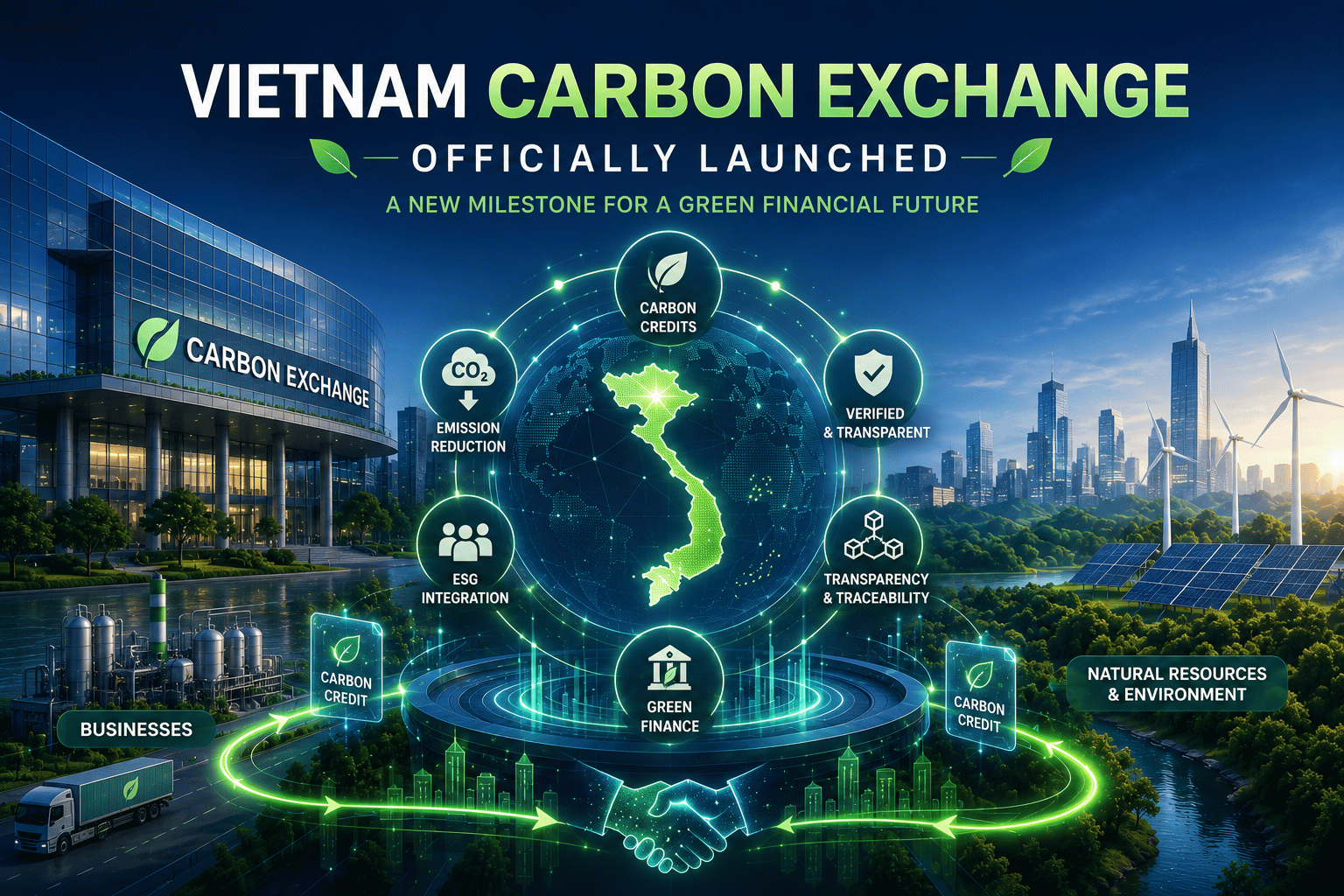
Vietnam’s domestic carbon exchange officially commenced operations on June 29, 2026, at the Hanoi Stock Exchange (HNX), marking a significant milestone in the Government’s roadmap for establishing a national carbon market. The launch ceremony, jointly convened by the Ministry of Finance and the Ministry of Agriculture and Environment, constitutes a concrete step toward fulfilling Vietnam’s commitment to achieving net-zero emissions by 2050, as pledged at COP26.
(Source: Dan Tri Newspaper, July 4, 2026 – dantri.com.vn)
The exchange was established pursuant to Prime Ministerial Decision No. 232/QĐ-TTg on the Scheme for the Establishment and Development of Vietnam’s Carbon Market, together with Decree No. 29/2026/NĐ-CP governing the operation of the domestic carbon exchange.
Implications for the Agriculture and Forestry Sector
According to the General Statistics Office (Ministry of Finance), while the exchange’s activities are not directly reflected in the production value of the agriculture and forestry sector, they are anticipated to generate substantial indirect benefits, particularly with respect to forest management, protection, and development. As the carbon market develops further, revenue derived from the origination and trading of carbon credits may be allocated to forest owners, thereby aligning their economic interests with national emissions-reduction objectives.
Significance for the Business Community and Financial Markets
The State Securities Commission has indicated that the carbon exchange was established to provide a transparent and publicly accessible mechanism for trading greenhouse gas emission quotas and carbon credits, while contributing to the formation of a market-based carbon pricing mechanism. This framework is expected to afford businesses greater flexibility in managing emissions-reduction costs, accelerating technological innovation, and meeting the requirements associated with deeper international economic integration.
Implications for Renewable Feedstock Enterprises
The launch of the carbon exchange represents a notable development for enterprises operating within the renewable feedstock value chain. Vinatoken Renewable Energy is illustrative of this segment. The company’s supply chain — encompassing used cooking oil (UCO), rubber seed oil, and agricultural biomass — is inherently linked to emissions-reduction outcomes, providing a foundation from which such environmental impacts may, in time, be translated into tradable value under the carbon market framework.
Through its adherence to international standards and an established traceability system for its raw material sourcing, Vinatoken Renewable Energy continues to strengthen the capabilities required to meet the verification standards applicable to carbon credit issuance. As Vietnam’s carbon exchange progresses toward full operational maturity, the company anticipates participating in this emerging ecosystem, thereby contributing to national emissions-reduction efforts while establishing an additional source of value within the green supply chain it has developed.