

Used Cooking Oil (UCO) is more than just waste that needs to be disposed of. With the right technology, UCO can be converted into a feedstock for producing Sustainable Aviation Fuel (SAF), helping reduce carbon emissions in the aviation industry.
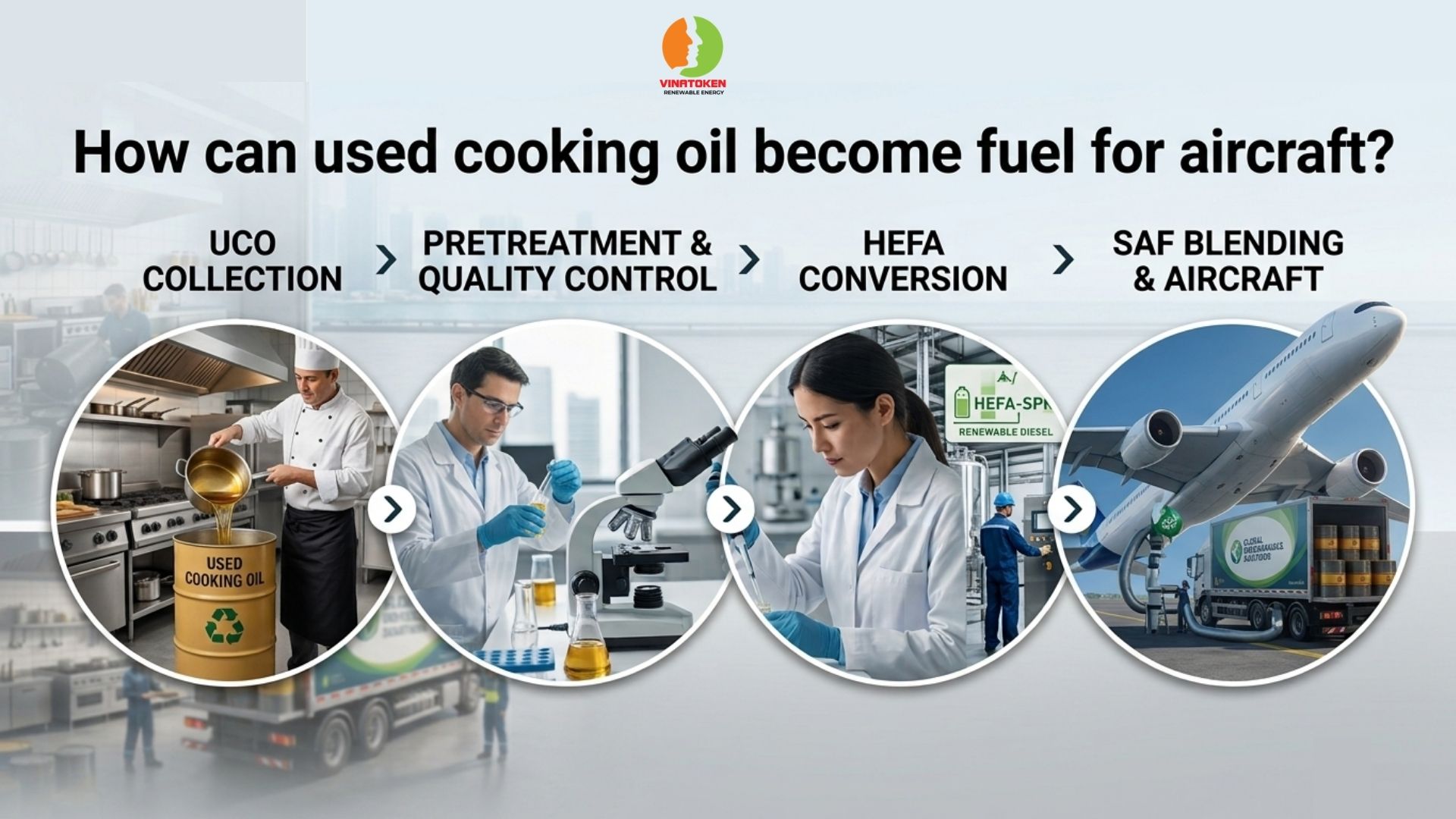
The journey from waste cooking oil to aviation fuel can be summarized as follows: UCO → Pretreatment → HEFA → SAF
So, how does this process work?
1. What Is UCO?
UCO (Used Cooking Oil) is cooking oil that has already been used, typically generated by restaurants, hotels, industrial kitchens, food processing facilities and other cooking operations.
After use, the oil may contain water, food residues, impurities, oxidation products and free fatty acids (FFAs). As a result, UCO cannot be used directly as aviation fuel.
However, when properly collected, quality-controlled and pretreated, UCO can become a valuable renewable feedstock for the biofuel industry.
UCO is currently one of the feedstocks used to produce SAF via the HEFA pathway. Both ICAO and IATA recognize used cooking oil as an important feedstock for SAF production.
2. From Used Cooking Oil to SAF
Step 1: UCO Collection
The process begins with collecting used cooking oil from various sources.
An effective collection system needs to ensure:
- Clear and verifiable feedstock origins;
- Consistent and reliable supply;
- Minimal contamination;
- Proper storage and transportation;
- Full traceability.
In the renewable fuels market, traceability is becoming increasingly important, as the value of a feedstock depends not only on its volume but also on the ability to verify its origin and sustainability.
Step 2: Pretreatment
Once collected, UCO undergoes inspection and pretreatment to remove or reduce unwanted components, including:
- Water;
- Solid residues;
- Impurities;
- Certain compounds that may interfere with catalysts and the production process.
The objective is to bring UCO into a condition suitable for subsequent conversion processes.
The more consistent the quality of the incoming UCO, the easier it is to control the production process.
Step 3: HEFA – Converting Oils into Hydrocarbons
HEFA (Hydroprocessed Esters and Fatty Acids) is one of the key technologies used to produce SAF from vegetable oils, used cooking oil and animal fats.
In the HEFA process, feedstocks are treated with hydrogen in the presence of catalysts to remove oxygen and convert the oil and fat components into hydrocarbons.
Subsequent processes, such as hydroisomerization and hydrocracking, modify the molecular structure and size to produce hydrocarbons suitable for aviation fuel.
ICAO identifies HEFA as an established SAF production pathway, with UCO among the feedstocks that can be used.
Step 4: HEFA-SPK and SAF
The suitable hydrocarbon product obtained through the HEFA process is known as HEFA-SPK (Hydroprocessed Esters and Fatty Acids Synthetic Paraffinic Kerosene).
HEFA-SPK can be used as a blending component in sustainable aviation fuel, provided it meets the applicable technical specifications and certification requirements.
According to ICAO, HEFA is one of the recognized SAF production pathways, with a maximum blending limit specified under the applicable standards.
It is therefore important to understand that: UCO is not fed directly into aircraft. It is the feedstock; HEFA is the conversion technology; and SAF is the final fuel produced in accordance with applicable technical specifications and standards.
3. Why Is UCO Gaining Attention in SAF Production?
The aviation industry is seeking ways to reduce carbon emissions while demand for air travel continues to grow.
SAF is considered one of the key solutions for reducing lifecycle emissions compared with conventional fossil-based aviation fuel. IATA reports that SAF can deliver significant lifecycle CO₂ emission reductions, depending on the feedstock, production technology and operating conditions.
In this context, used cooking oil offers an important advantage: as a previously used resource, it can be recovered and reintegrated into the value chain rather than discarded as waste.
This creates a circular economy model:
Food → Cooking Oil → UCO → Collection → SAF → Aviation
4. More Than Oil Collection: Building a Sustainable Feedstock Supply
As demand for SAF grows, UCO is becoming an increasingly valuable feedstock in the renewable fuels supply chain.
Therefore, the quality of a UCO supply is measured by more than just volume.
Three factors are becoming increasingly important:
🔺Quantity – Supply volume and the ability to ensure consistent availability.
🔺Quality – Feedstock quality and suitability for further processing.
🔺Traceability – The ability to verify feedstock origin throughout the supply chain.
This is why UCO collection and supply companies are becoming an increasingly important link in the renewable fuels ecosystem.
5. From Waste Cooking Oil to the Future of Renewable Energy
The UCO journey can be summarized as follows:
UCO ↓ Collection & Traceability ↓ Quality Control ↓ Pretreatment ↓ HEFA ↓ HEFA-SPK ↓ Blending & Certification ↓ SAF
Oil once regarded as waste can become a valuable feedstock for sustainable aviation fuel.
This is a compelling example of how the circular economy connects the food industry, waste collection and renewable energy.