
As businesses face growing expectations around environmental responsibility and sustainable development, measuring greenhouse gas (GHG) emissions is becoming an increasingly important part of corporate management.
A GHG inventory provides a structured view of emissions generated by an organization’s operations and value chain. Beyond measuring its carbon footprint, it helps businesses identify major emission sources, assess environmental impacts and establish a sound basis for future reduction efforts.
But what does GHG accounting involve, and what should businesses consider when developing an emissions inventory?
1. Understanding Greenhouse Gas Accounting
A greenhouse gas inventory is a systematic process of identifying emission sources, collecting relevant activity data and quantifying the GHG emissions associated with an organization’s activities over a defined reporting period.
Under the GHG Protocol, corporate emissions are classified into three scopes:
- Scope 1 – Direct Emissions: Emissions from sources owned or controlled by the organization, such as fuel combustion in boilers, generators and company-owned vehicles, as well as other direct emission sources.
- Scope 2 – Indirect Energy Emissions: Emissions associated with the generation of purchased or acquired electricity, steam, heating and cooling consumed by the organization.
- Scope 3 – Other Indirect Emissions: Emissions arising across the organization’s value chain, including purchased goods and services, transportation, distribution, waste generated in operations, business travel and other upstream and downstream activities.
Considering all three scopes gives businesses a broader understanding of their carbon footprint, extending beyond their own facilities and operations to include the wider value chain.
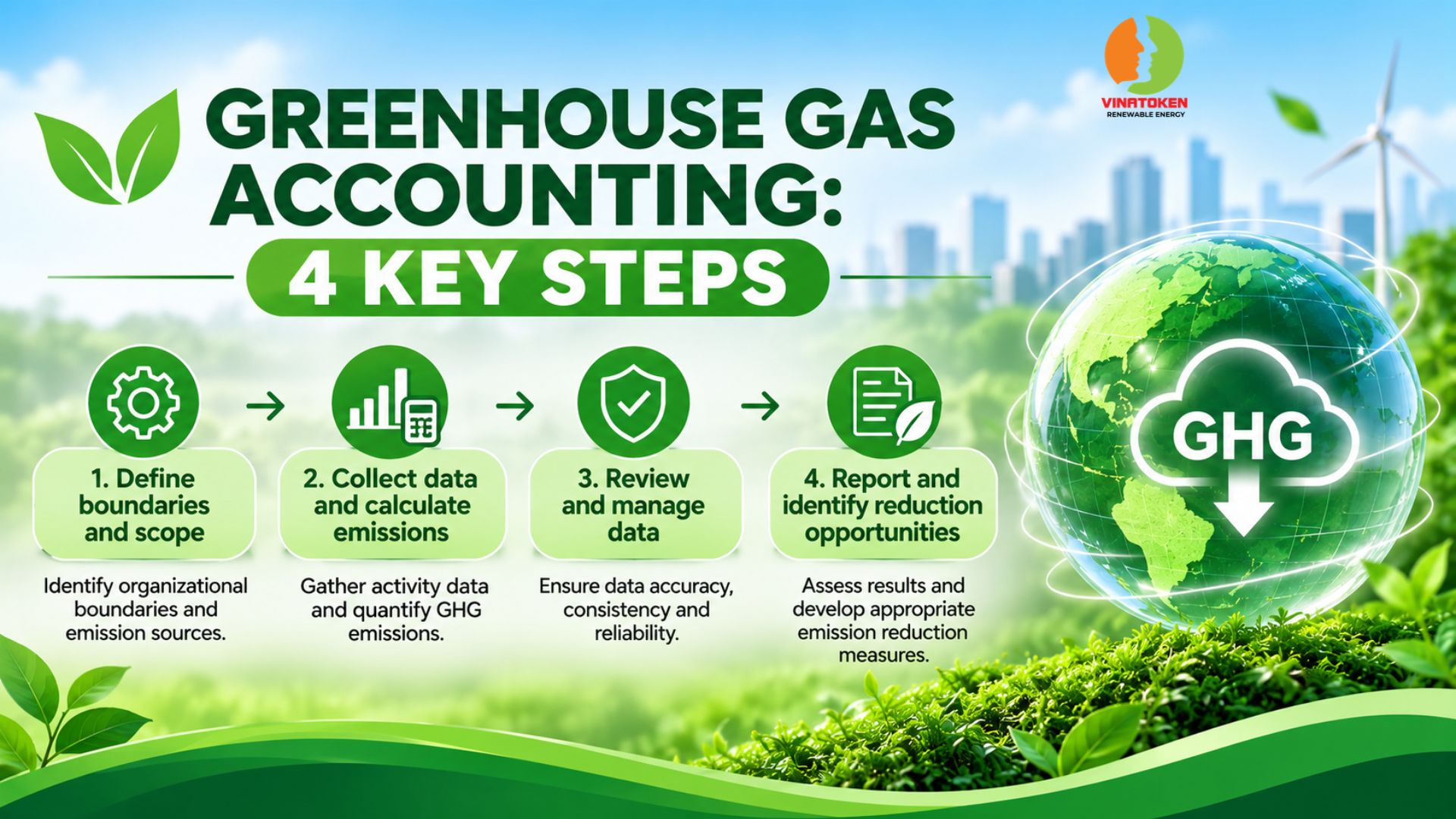
2. Four Key Steps in Developing a GHG Inventory
A reliable GHG inventory requires a structured approach, supported by consistent data collection, appropriate calculation methods and effective internal controls.
Step 1: Define Organizational and Operational Boundaries
The first step is to establish which entities, facilities, operations and activities will be included in the inventory. Businesses also need to select a base year – the reference year against which future emissions can be measured and compared.
Clearly defined boundaries help ensure that the inventory reflects the organization’s actual operations and provides a consistent basis for tracking emissions over time.
Step 2: Collect Activity Data and Quantify Emissions
Businesses identify and collect relevant activity data, including electricity consumption, fuel use, transportation activities, purchased materials and other sources of emissions within the defined inventory boundaries.
The collected data is then reviewed and combined with appropriate emission factors to calculate GHG emissions. Different greenhouse gases are converted into carbon dioxide equivalent (CO₂e), allowing emissions to be measured and reported on a consistent basis.
Step 3: Establish an Inventory Management Process
Reliable emissions reporting depends on more than accurate calculations. Businesses need clear procedures for collecting, reviewing, maintaining and managing inventory data.
An Inventory Management Plan (IMP) helps formalize these procedures, define responsibilities across departments and establish appropriate quality-control measures. This also supports future reviews and, where applicable, independent verification.
Step 4: Report Findings and Identify Reduction Opportunities
Once the data has been reviewed and consolidated, businesses can assess their overall emissions profile, identify major sources of emissions and determine where improvements may be possible.
These findings provide a basis for setting reduction targets, improving energy and resource efficiency, and monitoring progress over time.
3. From Measurement to Meaningful Climate Action
A GHG inventory is not simply a reporting exercise. Its real value lies in helping businesses understand where their emissions come from and where meaningful improvements can be made.
With a reliable emissions baseline, organizations are better positioned to integrate environmental considerations into business decisions, strengthen operational efficiency and respond to the growing sustainability expectations of customers, business partners and supply chains.
In line with this direction, Vinatoken Renewable Energy is currently undertaking its base-year GHG inventory, covering all three emission scopes: Scope 1, Scope 2 and Scope 3.
The work is ongoing, with a focus on building a structured emissions dataset and assessing the company’s emissions profile across the defined inventory boundaries. This process is intended to establish a reference point for future emissions monitoring and environmental management.
Measuring emissions is an important first step. Turning that data into informed decisions and practical improvements is what makes long-term climate action possible.
Better measurement today. More informed decisions for a sustainable future.
References:
- Dân Trí (November 7, 2026). Four Steps to Conducting a Greenhouse Gas Inventory in Line with International Standards
- GHG Protocol. Corporate Accounting and Reporting Standard. Guidance on corporate GHG accounting and reporting, including organizational boundaries and emissions classification across Scope 1, Scope 2 and Scope 3
- U.S. Environmental Protection Agency (EPA). GHG Inventory Development Process and Guidance. Guidance on inventory planning, data collection, emissions quantification, inventory management and emissions reduction tracking.